
TI Group in Persons: Interview with Tatyana Shangina, Business Development Director

Ask an author
To ask a question to Tatyana Shangina, click the button
Any business is about the people behind it. We’ve interviewed the CEO of TIGROUP, Tatiana Shangina about plans to conquer the European market, a new service of ABAP Assistance and her most memorable work experiences. Let's get to know the company better!
What is your main goal as the Head of TIGROUP?
My team and I have been involved in many international projects, including comprehensive roll-outs for global corporations. Our expertise in product and business development has always been recognized by industry leaders. That’s why we have been planning to work in the European market for a long time. Seven years ago, we opened a headquarters in Zug, Switzerland. Last year, we decided to expand and open a resource hub in Slovenia.
And how is European expansion going so far?
In Slovenia, we are newcomers. Last September, we opened a local office and started to relocate the team. In February, we signed our first contracts with several German companies and received official SAP Partner status.
The market is highly competitive, but our key advantage is our unique and deep expertise in automating complex logistic business processes based on SAP Digital Supply Chain solutions, including SAP EWM, TM, IBP, FSM and specific development using ABAP, FIORI, and Mobile UI tools. Now we see a high demand for experts with practical hands-on experience in these fields. So things are moving forward. Our brand has been developing, and our customer base in Europe is growing.
Could you share some light on your international experience? What companies have you been working with?
For the last 20 years, we have been implementing and localazing SAP solutions for international companies wanting to expand in the CIS. We’ve launched numerous large-scale implementation projects with strict requirements and complex processes. We had to develop non-standard solutions to meet specific business needs.
We’ve launched automation projects for international pharmaceutical companies such as Roche and Sanofi. We cooperated with companies in the chemical industry, including Solenis, Ashland, and Soudal. Among our clients were also home appliance manufacturers like Philips, Harman, and Samsung. We’ve also automated agro-sector companies.
Our resourcefulness showed that we can solve any client's tasks, even those that initially seemed impossible. We organised the joint work of colleagues from various parts of the globe. In one team, there could be people from the USA, India, and different countries in Europe.
International implementation projects require coordinated teamwork. The result depends not on the competencies of a single person but on good project management and finding common ground.
Tell us about ABAP Assistance. Why did you create this service?
The success of implementation largely depends on the work of the development team. As a senior manager, I was always responsible for the project's efficiency and tackled downtimes caused by a lack of urgently needed competencies on the project or poor planning.
Over the years, I have encountered numerous serious problems during launches, often due to the unrefined work of ABAP programmers. The recurring errors included a lack of code quality control, poor communication between programmer and the functional business team during task setting, programmers' lack of understanding of business processes, and conversely, the functional teams' lack of understanding of how development should be structured, resulting in non-universal solutions.
After encountering the same issues repeatedly, we developed a technology and approach to development – the ABAP factory, which evolved into the ABAP Assistance service. This service has proven effective in the CIS, with the project team's efficiency allowing our clients to reduce the cost of implementation, increase the quality and speed of development, and lower subsequent support costs.
The ABAP team we’ve relocated to Slovenia has a wealth of experience. They understand not only programming tools, they have good knowledge of system landscape and integration architecture, basic knowledge of logistic and financial business processes, but are also highly specialised in niche skills processes such as environment, health, and safety management (EHS) , warehouse management (EWM), yard and transportation management (YM and TM), and etc.
Thanks to their vast experience, they literally understand the task with a half-word: they often anticipate events that a consultant or client may not see coming. Our team can prevent problems that arise due to improper tasking from the very start.
What is the key difference between ABAP Assistance and hiring a remote developer?
This means we don’t need to find a specific person for an urgent development request. For our clients, there’s no need to involve the HR team and pay for project downtime during the search. We can respond the same day.
And, of course, our customers benefit from significant cost savings. For them, our whole team works as one FTE – as if cooperating with a remote team leader, but self-managing and possessing all the skills connected to ABAP.
Another significant aspect is code quality control. This is very important because inaccuracy when extending the system can sometimes bring the entire operation to a halt. We work in such a way that any error is eliminated at the testing stage on our side. These key advantages are why clients recognize us and often come back for further outsourcing projects.
Share with us your most memorable case from work, proving that impossible is possible?
We were handling the integration of S4/Hana with a POS solution for cash operations for one of the largest automotive spare parts online retailers in the CIS, processing more than 100,000 daily orders. After a long period in management, I wanted to “work with my hands,” so I decided to run the cashier integration by myself.
The deadlines were very tight: we had to convert the whole company with 300 subdivisions all over the CIS to the new system based on S/4HANA in 6 months. All the training had to be held remotely. In those “pre-Covid” times, in 2019, remote implementation and workshops were quite new; they were mostly run on-site.
We needed to set up the integration of the financial payment processes with the POS system and train hundreds of employees across different time zones to work with it. My personal challenge was that it was a completely new functionality for me as well. However, I was the only one to teach and support them all. It was pretty intense Go-live and Hypercare. I had dozens of calls. But as a result, everyone knew how to work with the absolutely new system and business had a successful Go-live.
The smooth work of our ABAP team greatly aided the integration development. During the system launch, we were able to quickly resolve all issues related to developments, and the start was smooth, although physically exhausting. That was the moment I realized that I should return to management… and that the impossible is possible.
Sometimes it is very useful to take on a challenge and test your professional skills.
Based on your experience, what would you highlight as a key success factor in your business?
The success of my work is measured by establishing trust-based relationships with our customers. Transparency is important. It is crucial to communicate project milestones clearly, be open, and always share the truth about how everything is going. Sometimes, it’s about viewing the situation from the customer’s side and correcting the process when you understand the consequences might be problematic.
And, of course, it is essential to sincerely want to work with your team and be happy with the results achieved. That’s why we try to make a product that we’d buy ourselves. And it works. We often become good friends with our clients. We do everything so that they can and want to contact us again and again. Therefore, the level of responsibility for the result is very high.
How do you unlock the potential of your employees at TI Group?
The main task is to discover what they are good at and develop it. I try to be morally supportive to the people I work with. I often remind them of the opportunities that await us just around the corner – for both major projects and personal growth.
Moreover, we try to build a strong team spirit by organizing corporate events, personal and group skill-building sessions, and supporting them within TI Group’s inner Competence Centre.
We set ourselves challenges outside of work as well – for example, our team recently participated in a running marathon, Pot ob žici, covering 47,000 steps and 33 kilometers. Achievements like this help us nurture team spirit and stay in the best shape – both physically and mentally.
Read more
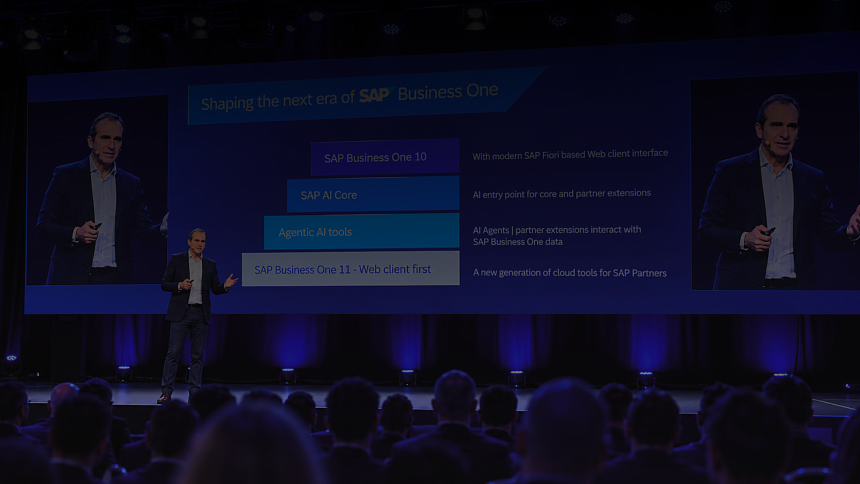
TIGROUP at SAP Partner Summit 2026: Business AI, Autonomous Enterprises and the Future of SAP
TIGROUP attended SAP Partner Summit for EMEA and MEE 2026 in Amsterdam on October 19–21, joining the SAP partner ecosystem to explore Business AI, enterprise technology roadmaps and new opportunities for digital transformation. The event brought together SAP leaders and partners to discuss how technology, collaboration and innovation are shaping the next generation of enterprise operations.


Simply About Simplification: 7 Hints not to Ignore When Moving to SAP S/4HANA
Your colleagues and associates from TIGROUP have prepared some simple tips for you. Don't forget to do this, take the right steps and always keep in mind these simple practical things that will help you migrate to new SAP cloud solutions with minimal costs.


How SAP’s Cloud Changes the Project During Transition
Transition from traditional SAP ERP system to SAP S/4HANA is no longer merely a technical upgrade. It represents a strategic shift toward a cloud-based operating model and fundamentally different implementation approaches. And in this strategic transition, your colleagues and friends from TIGROUP are ready to help you to make it as comfortable and cost-effective as possible.